
Though Indian banks don't have large exposure to subprime mortgages, analysts are worried at the rise in their restructured loan portfolios and deterioration in credit quality.

>It's not easy to predict the market. But there are at least two positive factors to back the PSU banks, explains Tamal Bandyopadhyay.

The National Company Law Appellate Tribunal (NCLAT) has allowed state-owned Canara Bank and Indian Bank to pursue proceedings against former IL&FS directors, who are not part of the new board, to declare them as wilful defaulter. However, the appellate tribunal said those directors who are part of the new board of Infrastructure Leasing & Financial Services (IL&FS) and its various subsidiaries after October 1, 2018, would remain protected.

The effect of the HDFC-HDFC?Bank merger will be for the bigger space of the Indian financial sector and not just limited to the banking sector. The large finance companies have practically no benefit of regulatory arbitrage. Earlier, such arbitrage between banks and NBFCs was normal. The logic of the merger is very clear - the cost of borrowing of banks is lower.

The government on Monday said that its mantra for banking reforms would be 'consolidation, competition and convergence' to enable PSU banks to become more stronger, bigger and globally competitive.

'40 percent of voters in Bihar will be excluded.'

Sitharaman said the government understands that the contours and tone of issues for each sector varied from one to the other.

Nationalisation has served its purpose. It's time to move ahead, keeping majority ownership of the government in a few banks to serve the people, argues Tamal Bandyopadhyay.

Dissatisfied with the wage hike offer made by Indian Banks' Association (IBA), public sector lenders' employee unions on Monday threatened to go on a two-day strike from February 10.

The agency said that over the next two years new NPL formation rates would witness a gradual decline.

'As long as Sebi maintains transparency and market stability, the Jane Street episode is unlikely to deter long-term foreign capital.'
Union Finance Minister P Chidambaram will meet the heads of public sectors banks and financial institutions, like IFCI and Small Industries Development Bank of India (Sidbi) on Tuesday to review their performance for the second quarter ended September 2008.

The government may delay Rs 14,000 crore (Rs 140 billion) fund infusion in the public sector banks in view of volatile market conditions.

Former RBI governor D Subbarao has suggested that the government should come up with a 10-year road map for privatisation of all Public Sector Banks (PSBs) as it would provide much needed predictability to stakeholders. Subbarao further said that the big bang approach to privatisation of state-owned banks is not desirable but at the same time the issue should not be put on the back burner. "Ideally, we should have a road map, maybe over a 10 year timeframe, to privatise all PSBs. "That will give much needed predictability to all stakeholders," he told PTI.

The Indian government has appointed Finance Secretary Tuhin Kanta Pandey as the new chairman of the Securities and Exchange Board of India (SEBI). Pandey, a 1987-batch IAS officer, will replace Madhabi Puri Buch, whose three-year tenure ends on February 28. Pandey's appointment comes at a time when the markets are experiencing bear pressure due to withdrawals by foreign institutional investors (FIIs). Pandey has extensive experience in the finance ministry, having served as the longest-serving secretary in the Department of Investment and Public Asset Management (DIPAM) and the Department of Public Enterprises (DPE). He also played a key role in the framing of the 2025-26 Budget and the drafting of the new Income Tax Bill. Pandey's appointment is for an initial period of three years.

Who else will take on the might of Microsoft, Google, and Amazon if not the Adanis, Ambanis, Birlas, or Tatas?, asks R Jagannathan.

Among other demands, the unions are also seeking immediate introduction of five-day week in full and reduction of cash transaction hours and regulated working hours.

The number of frauds in the banking sector increased over four times in the past five years to 36,075.

The first quarter of calendar 2023 will see new faces heading four large public-sector banks -- Canara Bank, Bank of Baroda, Indian Overseas Bank, and Bank of India.

Shares of state-owned bank stocks were under pressure on Monday due to muted deposit and credit growth numbers reported by these lenders in the October-December quarter (Q3) of 2024-25 (FY25). The Nifty PSU Bank index was down 4 per cent, with Union Bank of India emerging as the biggest loser as its shares fell 7.5 per cent to close at Rs 114.7, followed by a 5.7 per cent drop in shares of Bank of Baroda (BoB) to Rs 228 and a 4.7 per cent slide in shares of Bank of India to Rs 99.8 on the National Stock Exchange.

Finance secretary Rajiv Kumar was positive in formation of a committee consisting all concerned to address the issues arising out of the proposed merger of 10 banks including preserving the identity of all the banks.
Unions claimed that about 10 lakh staff and officers of public sector banks and some private sector banks are participating in the strike.

The DMK may consider a two-tier campaign, where they keep the focus on Chief Minister Stalin, as a senior statesman with 50-plus years of political experience, and let EPS and the BJP shout in the wilderness. In such a case, the second-tier may project Udhayanidhi as the contender and chosen obstructionist in Vijay's path. The attempt, if any, would be to reduce Vijay to Udhayanidhi's level when the former is aiming at Stalin and Stalin alone in the state's political horizon, predicts N Sathiya Moorthy.

A trends study conducted by India's Financial Intelligence Unit (FIU) has expressed suspicion that cryptocurrency is being used across the country in serious criminal acts like terrorist financing, fuelling secessionist activities, cybercrime, narcotics trafficking, illegal betting and gambling. The report, which was based on suspicious transaction reports and operational analysis, shared these trends and credible intelligence with law enforcement agencies.

The 'bad bank' -- which will help banks clear their balance sheets by transferring the NPAs to special purpose vehicles -- has been one of the most debated ideas for stressed asset resolution.

While the collapse of a large financial intermediary can wreak havoc on the system because of the interconnectivity, a large business conglomerate too can play spoilsport if the banks have too much exposure to the entity, explains Tamal Bandyopadhyay.

Let's work flat out and create a policy framework that fosters the growth of Indian non-family business VC and private equity firms. This will allow our Indian startups' dreams to flourish, explains Ajit Balakrishnan.

'We plan to launch new initiatives, including cash flow-based lending, to ensure borrowers are not burdened and can access funds more quickly.'

The bank unions had threatened to go on 4-day strike from February 25.

A 10-part series that explains all you want to know about how India's EPF turns a slice of your monthly salary into long-term savings, pension, and life insurance.
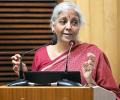
Finance Minister Nirmala Sitharaman on Wednesday asked fintech startups to come out with solutions to deal with the rising incidence of digital arrests, cheating by fly-by-night operators, and other kinds of cyber frauds. Speaking at the Digital Payments Awards 2025 ceremony here, the minister credited fintechs with helping speed up financial inclusion and taking the payment system to even the far-flung areas of the country.

In a written reply in the Rajya Sabha Minister of State for Finance Namo Narain Meena pointed out that this amounted to 3.48 per cent of the total advances given by the state-owned banks.

Banking services across the country were hit on Wednesday by the day-long strike by 10 central trade unions and 14 bank unions, but workers of largest lender SBI and a few other banks stayed off the agitation.

A consortium of Indian public sector banks led by SBI sought a bankruptcy order against embattled liquor tycoon Vijay Mallya during a high court hearing in London on Wednesday as part of efforts to recoup around 1.145 billion pounds in unpaid loans. Mallya's legal team, led by barrister Philip Marshall, argued for the bankruptcy petition to be dismissed because their client was being unfairly pursued by the banks in India and the UK on opposing grounds.

The draft digital personal data protection (DPDP) rules, which require banks to obtain explicit consent from their customers before using their data for purposes beyond the original intent, although is being followed in spirit, leaves no room for regulatory arbitrage, experts said. They said that the potential business impact is difficult to assess at this stage, but the formalisation of these rules will mean banks now need to establish clear data processing agreements with third-party entities to ensure compliance.
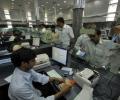
Many of India's sleepy state banks don't have the management capacity they need to tackle bad debts and deals at the same time, says Una Galani.

In a move to strengthen governance in private sector banks and wholly-owned subsidiaries of foreign banks, the Reserve Bank of India (RBI) on Wednesday directed them to have at least two wholetime directors. Lenders that do not meet the requirement will have to submit the names for the RBI's approval within four months. Banks need prior approval from the banking regulator for the appointment of wholetime directors.

IPOs have been the flavour of the season for some time. But the coming together of three mega IPOs, from diverse businesses and historic relevance, could tell a story that's still in the making, points out Nivedita Mookerji.

Public sector banks may have to bear a burden of Rs 1,800-2,000 crore arising due to a recent Supreme Court judgement on the waiver of compound interest on all loan accounts which opted for moratorium during March-August 2020, sources said. The judgement covers loans above Rs 2 crore as loans below this got blanket interest on interest waiver in November last year. Compound interest support scheme for loan moratorium cost the government Rs 5,500 crore during 2020-21 and the scheme covered all borrowers including the prompt one who did not avail moratorium.
